
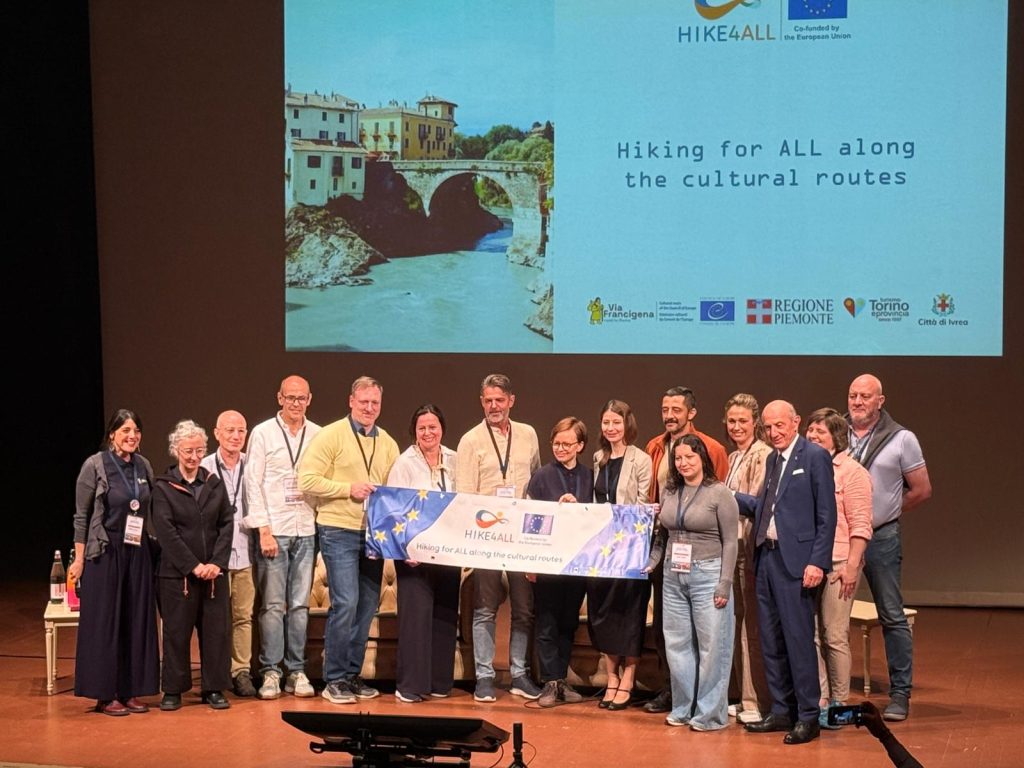
The HIKE4ALL project events, both those already implemented and still to come, offer a valuable opportunity to reflect on accessibility, share experiences, and examine the diverse approaches adopted across partner countries. The exchanges show that inclusion is understood in different ways across Europe, shaped by cultural, organisational, and territorial contexts, and help partners identify more coherent and effective approaches along cultural routes.
Led by AEVF, HIKE4ALL brings together six cultural routes: Camino Lebaniego (Spain), St. Olav Ways (Norway), Cyril and Methodius Trail (Czech Republic), St. Paul Trail (Türkiye), Templars Route (France), and Via Francigena (Italy). The events held in Ivrea, Italy, allowed partners to exchange experiences and build a common vision, and the testimonies collected confirmed the richness of different perspectives. Carlos Fernández Martínez (from Fundación Camino Lebaniego, Spain) described the experience as a concrete insight into the complexity of inclusive route management. Christophe Staf (from Templars Heritage Route European Federation, France) highlighted the strong human dimension of the meeting and the value of sharing experiences on the trail. Ilgın Tufan and Hüseyin Eryurt (from Culture Routes Society, Türkiye) underlined how walking alongside people with disabilities offered a deeper understanding of accessibility in practice. Martina Janochová (from European Cultural Route of Saints Cyril and Methodius, Czech Republic) emphasised the importance of dialogue and mutual learning between cultures, and Guro Vistad (from the Association for the Cultural Route of the St. Olav Ways, Norway) focused on focus on how to engage more people—especially those facing social challenges or vulnerabilities—in using nature in general, and pilgrimage trails in particular, as resources for physical and mental health, as well as personal growth. From the Italian perspective, Elena Dubinina (from the European Association of the Via Francigena, HIKE4ALL project coordinator) described the experience as deeply emotional, highlighting the strong participation in Ivrea and the meaningful atmosphere created by participants and families. She underlined how the project reshaped the idea of hiking itself, no longer only as a physical activity but as a more inclusive and meaningful experience. For AEVF, inclusion means ensuring that everyone — regardless of age, ability or background — can experience the Via Francigena in their own way, with a particular focus on accessibility for wheelchair users, visually impaired and deaf participants. Across all partners, inclusion takes different forms: from social reintegration programmes in Norway, to accessibility improvements in Spain, to inclusive cultural activities in France, and community-based approaches in Türkiye and the Czech Republic. Despite differences, a shared vision is emerging: making cultural routes more open, accessible, and meaningful for all.
READ THE FULL INTERVIEWS IN ENGLISH HERE
[Photo credits: AEVF]